Tuesday, April 01, 2008
Jimat dan Senang Kira

Wednesday, March 26, 2008
History of Unit Trusts
Malaysia introduced the unit trust concept relatively early compared to its Asian neighbours, when, in 1959, a unit trust was first established by a company called Malayan Unit Trust Ltd.
The unit trust industry in Malaysia has therefore a history of more than four (4) decades. The development of this industry can be presented in chronological order as follows:
The Development of Unit Trusts
- The Formative Years: 1959 -1979
The first two decades in the history of the unit trust industry were characterised by slow growth in the sales of units and a lack of public interest in the new investment product. Only five unit trust management companies were established, with a total of 18 funds introduced over that period. The industry was regulated by several parties including the Registrar of Companies, The Public Trustee of Malaysia, Bank Negara Malaysia and the Ministry of Domestic Trade and Consumer Affairs.
The 1970s also witnessed the emergence of state government sponsored unit trusts, in response to the Federal Government's call to mobilise domestic household savings.
- The Period from 1980 to 1990
This period marks the entry of government participation in the Unit Trust Industry and the formation of a Committee to regulate the unit trust industry, called the Informal Committee for Unit Trust Funds, comprising representatives from the Registrar of Companies (ROC), the Public Trustee of Malaysia, Bank Negara Malaysia (BNM) and the Capital Issues Committee (CIC).
The 1980s marked a significant development in the history of the industry when the Skim Amanah Saham Nasional (ASN) was launched by Permodalan Nasional Berhad (PNB) in 1981. Despite only 11 funds being launched during this period, the total units subscribed by the public swelled to an unprecedented level because of the overwhelming response to ASN.
The 1980s also witnessed the emergence of more unit trust management companies, which were subsidiaries of financial institutions. Their participation facilitated the marketing and distribution of unit trusts through bank's branch network which widened investor reach.
The Period from 1991 to 1999
This period witnessed the fastest growth of the unit trust industry in terms of the number of new management companies established, and funds under management. The centralisation of industry regulation, with the establishment of the Securities Commission on 1 March 1993, coupled with the implementation of the Securities Commission (Unit Trust Scheme) Regulations in 1996 and extensive marketing strategies adopted by the ASN and ASB (Amanah Saham Bumiputera), played key roles in making unit trusts household products in Malaysia. Consequently, the total asset value of funds under management grew more than threefold from RM15.72 billion at the end of 1992 to RM59.95 billion at the end of 1996. The period also saw greater product innovation and deregulation of the industry.
Although the pace of growth of local unit trust funds has moderated since the financial crisis of 1997-1998, it has nevertheless maintained its upward trend.
- The Period from 2000 to current
In 2005 the unit trust industry experienced another year of strong growth which saw the net asset value of managed funds capitalising 14.2% of Bursa Malaysia’s market at RM98.5 billion at the end of 2005. Further, the liberalisation of overseas investment rules (such as the increase in overseas investment limit from 10% to 30%) by Bank Negara Malaysia has seen unit trust management companies launching numerous offshore funds or realigning investment strategies of domestic funds to invest offshore up to the permitted limit which resulted in the launch of 10 offshore funds with an intended overseas investment exposure of more than 50%. As at the third quarter of 2006 the number of offshore funds with an intended overseas investment exposure of more than 50% is 38 which is clear evidence of the continued interest by the investing public for a better slice of the overseas market.
Friday, February 29, 2008
Public Mutual emerged as the biggest winner for the 5th consecutive year at The Edge-Lipper Malaysia Fund Awards 2008
Public Mutual’s Chairman Tan Sri Dato’ Sri Dr. Teh Hong Piow said that he is very proud that Public Mutual continues to win the most number of awards at this year’s The Edge-Lipper Malaysia Fund Awards. “The icing of the cake is this is the fifth straight time that we have done it,” he added.
He attributed the company’s success to its effective investment strategies. He also thanked the fundholders for their confidence and support.
The awards were presented by Y.Bhg Dato’ Zarinah Anwar, Chairman of the Securities Commission Malaysia to Public Mutual’s Chief Executive Officer, Yeoh Kim Hong and the investment team during the award presentation ceremony which was held on 26 February 2008 at the Hilton Kuala Lumpur Hotel.
The 8 awards won by Public Mutual are:
Public Mutual Berhad: Best Equity Group Award, 3 Years
PB Fixed Income Fund
Bond Malaysian Ringgit, 5 years
PB Growth Fund
Best Equity Malaysia Fund, 5 years
Public SmallCap Fund
Best Equity Malaysia Small and Mid Caps Fund, 5 years
PB Balanced Fund
Best Mixed Asset Malaysian Ringgit Balanced Fund, 5 years
Public Ittikal Fund
Best Equity Malaysia Fund, 5 years
Public Bond Fund
Best Bond Malaysian Ringgit Fund, 10 years
Monday, December 31, 2007
Wednesday, October 10, 2007
Wednesday, September 12, 2007
Balanced Funds: A Safer Approach To Investing In Volatile Markets
In times of volatile market movements, it is a challenge for some investors to keep their emotions in check. When markets are in a strong rally, our herd instinct compels us to join the crowd and ride with the upside. But when markets correct, we are prone to sell out in panic. Yet, the wisest thing for investors to do at such times may be to remain calm and maintain a focused approach for their investments. Keeping an investment portfolio that is invested across different asset classes is a sound and effective strategy to ride through periods of adverse market movements.Stock markets are volatile by nature and as illustrated in recent weeks, extended periods of rising share prices can often be interrupted by sudden bouts of consolidation. In such times, investors with moderate risk profiles should consider holding a balanced fund which is invested in both equities and bonds in near equal proportions. Balanced funds aim to provide income and capital growth over the medium to long term period by adopting a balanced asset allocation approach - 40% to 60% of the fund's Net Asset Value (NAV) is invested in equities while the balance is invested in debt securities and liquid assets. In comparison, equity funds generally have asset allocations of 85% or more in equities and the balance in fixed income securities and liquid assets.
The main benefits of investing in balanced funds are:
1. More Stable Returns: The overall portfolio risk of a balanced fund is reduced because the returns of equity and bond investments are generally not positively correlated. The potentially higher but more volatile returns from equity investments are moderated by the fund's investment in bonds. As a result, the returns of a balanced fund should be less volatile than a conventional equity fund.
2. Rebalancing: Another benefit of balanced funds is that in times of rising markets these funds "automatically" rebalance the portfolio by taking profits on equity investments which have appreciated and rebalancing the portfolio to its original equity: bond asset allocation of 60:40. Thanks to this rebalancing process, the unit trust investor need not worry about when to take profits on their investment.
3. Capital growth: A balanced fund will allow the investor to participate in the long term capital growth of equity markets because a sizable portion of up to 60% of the fund is invested in equities.
In conclusion, balanced funds are suitable for medium to long term investors with conservative to moderate risk reward temperament with a preference for receiving income and a respectable measure of capital growth. Investing in a balanced fund helps unit trust investors stay focused on achieving their long term investment goals without requiring them to evaluate the prevailing market cycle. Once they have selected a well-managed balanced fund in line with their risk profiles and investment objectives, they can be assured that the managers of the fund will take the necessary steps to rebalance the fund on a regular basis.
Sunday, July 22, 2007
Q : Which is a better investment ~ stock market shares or unit trust ?
Unit trust funds are less risky than investing directly in the stock market. You reduce your risk by spreading your money over a diversified portfolio of assets, which typically includes securities in different companies, sectors, countries or regions.
A unit trust scheme offers you a simple, convenient and time-saving method of investing. You rid yourself of the unnecessary paperwork that come swith managing your own stocks and shares.
The minimum initial investment amount in most unit trusts is relatively low, making them more affordable than direct investment in securities.
Sunday, December 31, 2006
年末,工作人請問問自己──是雞還是豬?
為什么?
分別在於,雞一天下一個蛋,兩天生產兩個蛋,就足夠應付一份美式早餐的需求,毫髮無損。
豬可不一樣了,一片片的培根,卻是豬賠了老命換來的,跟下蛋的雞比起來,豬當然覺得美式早餐很貴啊!
其實,故事要表達的,是企業里兩種員工的心態,雞提供勞務換取所需,但是不賣命,這樣的員工是屬於 "Contribution "(貢獻)類的打工型(通是中下階層員工)。豬則是屬於"Commitment "(承諾)一類,就是為了公司好,命賣掉也在所不惜的死忠型(多半是高階主管)。
公司里,如果員工都是雞,就會有流動性高、無法長期經營、應付激烈競爭的問題;假如豬太多,很容易造成內鬥嚴重、沒有活力,到頭來變成一灘死水,無法創造新局。
所以,每家企業必須找出正確、適當的豬和雞的比例,才能應付生存的挑戰。
*以上為城邦出版集團雜誌專欄文章
Tuesday, November 07, 2006
KLCI surges past 1,000 points to hit 6 1/2-year high
The Kuala Lumpur Composite Index of 100 blue chips rose 1 percent to 1,003.28, the highest close since March 2000.
Dealers said the market may strengthen over the next few days as institutional funds appeared to be snapping up stocks in potentially high earnings growth sectors such as construction and plantation.
Among the biggest movers, plantation firm KL Kepong soared 4.8 percent to 13.10 ringgit and IOI Corp. was up 2.2 percent at 18.40.
Conglomerate YTL Corp. gained 3.7 percent at 5.65 ringgit, MMC Corp. surged 8.9 percent to 3.66 after it landed a project in Saudi Arabia and Malaysia Airlines rose 5.7 percent to 3.70.
Thursday, October 26, 2006
Bonds can provide good returns, too by YEOH Kiat Seng
Actually it takes only RM250,000 to invest directly in bonds, while for RM500,000, you can have a bond portfolio managed by professionals.
Not exactly pocket change, but certainly affordable to those who are priority banking clients. Investing in unit trust bond funds of course starts with only RM1,000.
Bonds today are far from being a household investment among retailers, with most Malaysians remaining fixated on equities. As fixed deposits are deemed sufficient for savings needs, bonds are left to straddle the “no man’s land” between the two.
This is quite a shame as bonds hold so much promise in catering to the needs of investors, conservative or otherwise.
Yet its potential remains largely latent, as the penetration of bond ownership among Malaysians, even those with high net worth, remains very low despite the pace at which the bond market has developed.
Bonds work on the principle that by disintermediating banks i.e. bringing borrowers and lenders together and cutting banks out as the middlemen, the spreads that the latter earns are also carved out and shared between the two.
Consequently, the investor earns a higher yield and the borrower enjoys a lower borrowing cost.
This ability to generate a higher yield traded off against a slightly higher risk, accords bonds their biggest appeal. For investors who can afford to hold bonds to maturity, the main risk is credit risk, risk of issuer defaulting on interest or principal payment. This may be higher than that of a bank, although not necessarily always so.
The risk gap between bonds and fixed deposits (FDs) is often not that wide. Historically, the incident of default for A-rated bonds has been insignificant except for a spike in 1998 during the Asian crisis.
Default of AA bonds is extremely rare, while AAA bonds have never defaulted before. Given these favourable odds, credit risk can be reasonably managed with proper selection and monitoring.
In many ways, bonds are very similar to FDs. Both are fixed-income instruments – returns are known in advance if held to maturity. They provide regular income and depending on the bond rating, are able to satisfy the principal protection needs of investors, at least for the conservative part of their portfolio.
In my opinion, bonds are close substitutes for FDs, yet better on several counts. Returns are almost always superior, providing an inflation hedge. Also, investors are able to strive for higher yields by assuming credit or interest rate risks.
FD rate differentiation among banks tends to be fairly low, and even with longer tenures, the yield pick-up is usually not substantial. Further, interest from bonds is tax-free for individuals, unlike FD interest where there is a 5% withholding tax for FDs of more than RM100,000.
Investors who need to borrow money can pledge their bonds as collateral for loans, similar to FDs. The advantage though, is that they can actually make money by doing so via a reverse repo facility, using the proceeds to invest back in bonds and earn a yield higher than borrowing cost. He cannot make such a gain putting the money in FDs.
Bond investors who need to raise funds by selling their bonds will not lose out on interest accrued up to the date of sale, as the interest is built into the selling price. Fixed depositors will, however, lose the bulk of their accrued interest if FDs are uplifted early.
There are, however, some areas aside from credit where bonds are riskier than FDs. Investors who sell their bonds instead of holding them to maturity face interest rate risk i.e. the possibility of the bonds’ value falling when interest rate rises.
This risk has traditionally been manageable given our stable interest rate environment, save for the Asian crisis. Investors who do not sell their bonds will not incur realised losses, but there would be an opportunity loss as they could have obtained higher yields buying the bonds later.
Another risk faced by bond investors is liquidity risk. Because some bonds are not actively traded, there are occasions when investors cannot sell simply because of a lack of demand.
Once again, this risk crops up only if the investor has to sell pre-maturity or if he intends to trade in bonds rather than have a buy-and-hold strategy.
Because there is volatility in bond prices unlike FDs, it is an investment rather than a savings instrument. Just as there is a risk of bond values falling when interest rate rises (or credit quality deteriorates), there is also an opportunity to gain when interest rate falls (or credit quality improves). Investors who can time the market can enhance their return beyond simply earning a yield from holding bonds.
Given the widely shared belief that our interest rates have peaked or are close to peaking, interest rate risk is currently low compared with before. If anything, there is probably a greater likelihood of bond values rising when interest rates start to soften over time.
One can also invest in bonds via unit trusts and discretionary funds. The former’s advantages are that it requires only a small investment for investors to afford diversification and professional management.
The additional risk though is the volatility of returns during periods of massive redemptions. Investing via discretionary bond funds helps overcome this disadvantage, but the minimum investment is higher.
Bonds offer one of the highest returns per unit of risk as one moves up the risk-return curve.
I believe ownership of bonds by individual and corporate investors is likely to grow significantly over time as conservative investors grow increasingly aware of its benefits, while moderate to aggressive investors learn to appreciate that bonds and equities are not mutually exclusive in a portfolio but should co-exist to achieve diversification.
Friday, October 20, 2006
When There's a WILL...
We all know we should do it but more than 80% of Malaysians over the age of 18 have not written a will. What is more shocking is that more than 80% of parents with children below the age of 18 do not have a will. This means that should anything happen to one or both parents, thier children are not provided for financially. And there is no legal guardian for the children.- I'm still young, I'll write it when I'm older.
- My spouse will know what to do.
- I don't have anything of value to leave to my family or I'm not rich so I don't need a will.
- I don't know what to do or who to ask.
- If I write my will, then I'll die faster.
- I don't have time to do one now, maybe later.
- Wills are only for the erderly, the sick or the dying.
- To control your property and family after you die.
- Allows you to designate the guardian of your child(ren) after your death.
- Appoint the appropriate person to administer your estate to your beneficiaries.
- If you without a will, it takes long time to sort out your estate and this delay may cause financial hardship on your family members.
- Avoid legal tussles on who has claim on your property and your children.
- Do not assume that if you die without a will, your assets will automatically go to your spouse and children. Your parents and siblings may have a claim too.
- Make a list of all the people you would like to name as beneficiaries.
- Make a list of all your assets - property, bank account, business assets, shares in public listed companies, foreign assets, insurance policies, etc.
- If you have made an earlier will, then you will have to revoke any previous wills.
- Provide directions on your wishes for your funeral - it is not incommon for family members to argue over which religious ceremony should be followed where the members are of different religious denominations.
- Decide whoshould be your executors (If this is an individual, there should be more than one, in the event that he or she dies before you), trustees and witnesses.
- Decide on who you and your spouse would like to appoint as your children's legal guardian and ask them to agree to this appoinment. It is an idea to have alternatives, in the event that the first choice is no longer available to carry out the appoinment.
DID YOU KNOW?
- Marriage revokes a will that was excuted prior marriage.
- Conversion to ISLAM revokes a will, the estate is then governed by Syariah Law.
- If you die with no relatives and no will, your estate goes to the Malaysian Government.
Monday, July 31, 2006
TOP 10 Money Rules
- Save your money and get interest. Work to make money at the same time.
- Always have and work towards a financial goal. Adjust your goals as necessary but never abandon them.
- Begin a retirement and investment account now. The earlier you start a long term savings/investment account, the bigger the payoff in the future.
- If you don't have the CASH to pay for it, you can't afford it. Bring able to make the instalment payments doesn't mean you can afford it.
- Money isn't everything and greed is not good.
- Save at least 10% of each and every paycheque. Force yourself to do this. It will pay off in the LONG run.
- A sale in a store is not a sale if you can't afford it.
- Earn some, save some, spend some.
- Spend less than you earn.
- If your outflow exceeds your income, your upkeep will be downfall.
Saturday, July 01, 2006
June 2006 Market Review and Outlook
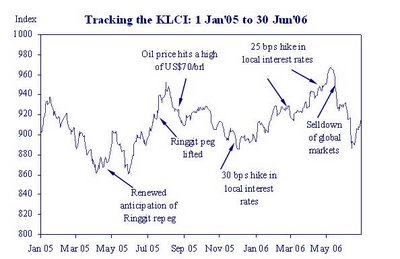
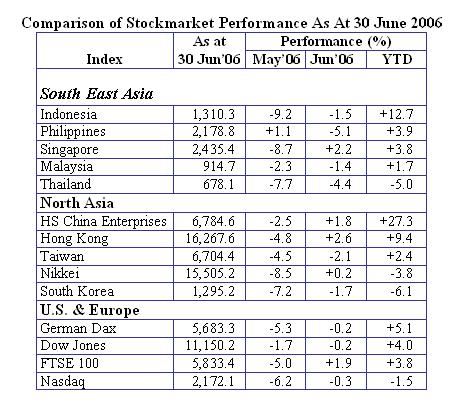
Commencing the month at 930.4 points, the KLCI fell amidst continued declines in regional markets to its year low of 883.2 points in mid-June. However, a rebound in global and regional markets towards the end of June helped the KLCI to close at 914.7 points for a reduced loss of 1.4% for the month of June 2006.
Regional markets closed on a mixed note as concerns of excessive tightening of U.S. monetary policy by the U.S. Federal Reserve diminished. A rebound on Wall Street caused selected regional markets to stem earlier losses in late June. South East Asian markets generally closed weaker while North Asian markets managed to register marginal gains in June.
On Wall Street, the Dow also eased to near its year low of 10,667.4 points in mid-June on concerns of further interest rate hikes before rebounding to 11,150.2 points, down by a marginal 0.2% for the month. The Nasdaq closed 0.3% lower at 2,172.1 points over the same period.
Malaysia’s export growth slowed to a 9-month low of 6.3% in April from 9.5% in March and 11.9% in 1Q2006 due to slower exports of electronic & electrical and commodity products. Likewise, import growth also eased to 11.4% in April from 14% in March on weaker imports of capital and consumption goods. As a result, Malaysia’s trade surplus narrowed to RM7.2bil in April from RM9.6bil in March. The cumulative trade surplus for the January to April 2006 period of RM33 bil is about the same level as the previous corresponding period in 2005.Domestic demand remained resilient with consumer loans growth moderating slightly to 17% in May from 18.6% in April as demand for vehicle financing weakened amid uncertainty over the outlook for car prices. The banking system’s overall loans growth remained stable at 8.9% in May on the back of firm demand for corporate loans.
Malaysia’s foreign reserves rose by a bigger margin of RM10.5bil in May to RM289.5bil as at 31st May compared to an increase of RM7.4bil in April. The increase in reserves is attributable to higher repatriation of export earnings and net capital inflows.
The local inflation rate eased to 3.9% in May from 4.6% in April as transport costs rose at a slower pace of 12.4% in May compared to 16.9% in April. However, the inflation rate is expected to remain high in coming months following Tenaga’s hike in electricity rates with effect from 1st June.
On the international front, economic activities in the U.S. show signs of moderating with the U.S. durables goods order growing at the slowest pace in 10 months of 3.3% in May from 10.8% in April following a sharp fall in civilian aircraft orders. However, consumer confidence as measured by the Conference Board rebounded slightly to 105.7 in June from 104.7 in May due to expectations that the business outlook and the job market are likely to improve.
The U.S. inflation rate rose to a 7-month high of 4.2% in May from 3.5% in April due mainly to higher fuel prices while core inflation (excluding food and energy) edged up to a 15-month high of 2.4% from 2.3% over the same period.
The Federal Reserve raised the Federal funds rate for the 17th time by 25 basis points to a 5-year high of 5.25% at the FOMC meeting on 29th June. Although the Federal Reserve stated that economic growth is moderating from its strong pace earlier this year, it noted that some inflationary risks remain and the outlook for interest rate policy will depend on the incoming data.
On the currency front, the U.S. dollar strengthened by 2.8% against the Euro and 4% against the Yen respectively in June on expectations that U.S. interest rates will continue to exceed interest rates in Europe and Japan. The U.S. dollar also appreciated versus other regional currencies amid the recent correction in emerging markets. The Ringgit eased by 1.5% to RM3.69 against the U.S. dollar for the month. Meanwhile, oil prices moved in a trading range around the US$70/brl level in June before ending the month unchanged at US$71/brl.
Stockmarket Outlook
The sharp correction in global and regional financial markets in May and June was triggered by concerns that an overtightening of U.S. monetary policy by the U.S. Federal Reserve could lead to a sharper-than-expected slowdown in the global economy. After making 17th consecutive hikes in interest rates, the U.S. Federal Reserve may be reaching the end of its monetary tightening cycle with a potential pause in interest rates after another potential hike at the 8th August FOMC meeting.
Despite concerns over the effect of tighter monetary policies, global economic growth is still expected to be sustained at between 4% and 5.0% this year compared to 4.8% last year. The anticipated slowdown in U.S. economic growth could be mitigated by the current strengthening of the Japanese and Euroland economies while China continues to grow at a strong pace.
On the regional front, economic growth is expected to moderate in most Asian economies in 2H2006 as global demand for manufactured exports weakens in tandem with the anticipated slowdown in the U.S. economy. However, selected regional economies with a significant domestic sector may be able to mitigate any slowdown in the external environment. On the valuations front, the recent sell-down in regional markets has sufficiently discounted the risk of overtightening by the U.S. Federal Reserve as valuations of selected regional markets have reached fairly attractive levels.
On the local front, Bank Negara is expected to maintain a tightening stance on monetary policy to keep inflationary pressures under control and ensure that real interest rates remain positive. However, the anticipated hikes in domestic interest rates in 2H2006 are expected to be moderate given the prospect of a peaking in U.S. interest rates by August 2006 and the high levels of liquidity in the banking system.
Despite the challenging external environment, Bursa Securities is a defensive market underpinned by fair valuations and reasonably attractive dividend yields. Bursa Securities’ P/E rating of 14.7x 2006 earnings is 17% below the 7-year historical average (1999-2005) of 17.7x. The market is underpinned by a gross dividend yield of 4.5% which compares favorably to Ringgit fixed deposit rates for less than a year’s tenure.
Wednesday, March 29, 2006
Benefits of Investing in UNIT TRUST
Unit trust funds provide you with a simple, convenient and less time-consuming method of investing in securities compared to investing directly in the stock market or any other eligible market. As an investor you are able to benefit from the expertise of full-time professional fund managers without the need to worry about what kind of securities to buy and when to get in and out of the market. By investing in unit trust funds, you have the opportunity to spread your money over a diversified portfolio of assets which otherwise may not be possible on your own.In brief, the benefits you will get to enjoy with unit trust investment are:
Professional investment services
Diversification opportunities and minimised risks
Affordability
Convenience
Liquidity
Note: Any investment carries with it an element of risks. Therefore, prior to making an investment, prospective investors should consider the risk factors.
Thursday, January 05, 2006
The PRESENT
Saturday, December 31, 2005
The Financier QUOTES
With money and wine, you will have many friends, but when you are in trouble, will you see even one?
When it comes to money, it's better to do nothing than to do something you don't understand.
The easier way for your children to learn about money is for you not to have any.
Friday, August 05, 2005
Wealth Accumulation Insurance
Not all of us are born with a silver spoon. Many believe that low and moderate income families cannot afford to save and build wealth. Yet, everyone has the ability to accumulate wealth over time. Through contributions to a retirement program, education investments, and other savings during their working years, most can accumulate six-figure assets. Accumulating wealth is not a mystery. It simply takes time, patience and the following7 steps:- Think long term and have realistic goals.
- Know your risk appetite.
- Start immediately.
- Invest systematically/regularly.
- Diversify your investments.
- Take advantage of tax reduction strategies.
- Stay on the course.
Monday, August 01, 2005
Mode of Investment
EPFThis allows you to invest part of your EPF Savings into our full range of unit trust funds. By investing some of your EPF Savings in a unit trust fund, you have the opportunity to achieve potentially higher returns on your savings over the long-term.
(a) How does it work?
- You must be below 55 years of age.
- You are only allowed to withdraw and invest 20% (at any one time) of the amount in excess of RM50,000 from your EPF Account 1, subject to a minimum investment of RM1,000. This means you must have at least RM55,000 saved in your EPF Account 1.
- Investments to a unit trust fund from your EPF Account 1 can only be made once every 3 months.
- Any income distributions paid by the unit trust fund will be considered as EPF savings and must be reinvested into additional units of the fund.
- You are redeeming your units in the unit trust fund, your redemption proceeds will be returned to your EPF Account 1.
Example:
Total Savings in Account 1
RM130,000
Required Balance in Account 1
RM50,000
Excess Amount
RM80,000
Investable Amount (20% x RM80,000)
RM16,000
(b) What do I do next?
Forward the following:
- completed application form;
- photocopy of your identity card or passport duly thumb-printed; and
- completed KWSP 9F (AHL) (obtained from the EPF or from any of our offices) duly thumb-printed.
SAVINGS PLAN
Our Savings Plan allows you to invest smaller amounts on a regular basis. Though it may seem small at first, each month's contribution can develop into something quite substantial over time.
Our Savings Plan helps you to invest a fixed sum of money every month. This saves you the hassle of timing your investment. With a constant investment amount, you will buy more units when prices are low and fewer units when prices are high. This can work out to your advantage and is known as the Dollar Cost Averaging concept.
LUMP SUM
Under this option, you may invest at any time by cash in a lump sum, subject to the respective Funds' minimum initial investment and additional investment. You may invest a small lump sum, leave it to accumulate and assign amounts whenever you are able to invest.
Do's and Don'ts of Choosing a Unit Trust Fund
Do
- Decide which type of unit trust fund meets your saving needs.
- Shop around for a reliable unit trust company.
- Check whether investment limits, frequency of income payments, etc, are suitable.
- Check past performance records.
Don't
- Don't choose any unit trust fund just because its performance has been good, make sure it is the right fund for you.
- Don't pay too much attention to short term performance, good consistent performance over all periods is the best lead.
- Don't decide on a unit trust fund just because it has low charges, good performance is far more important.
- Don't borrow to invest in unit trust unless you are absolutely aware of the risk involved.